SVM's, particularly hyperplanes through space
Look at morpho-guessing
Ontology to NER, classes/groups
java method 3Dto2D
http://tinyurl.com/p5sr7
http://tinyurl.com/pkf8o
http://tinyurl.com/m43t2
Monday, April 10, 2006
Tuesday, March 28, 2006
Here is also an interesting bit of info
This is something i wasn't really aware of.
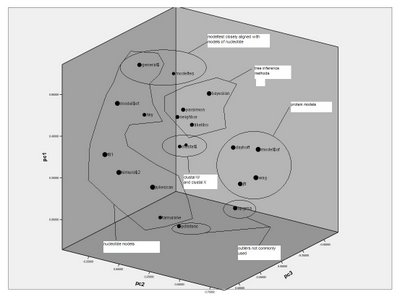
In a scan through ~200 journal of virology papers with the search "phylogenetic*" in abstract or title, maximum likelihood was the most popular tree-inference method. closely followed by neighbor-joining and the jukes-cantor model of nucleotide substitution was the most popular from the list screened (see below). Also the command-line only version of clustal; version w was much more popular than the GUI/user-friendly clustalX.
In a scan through ~200 journal of virology papers with the search "phylogenetic*" in abstract or title, maximum likelihood was the most popular tree-inference method. closely followed by neighbor-joining and the jukes-cantor model of nucleotide substitution was the most popular from the list screened (see below). Also the command-line only version of clustal; version w was much more popular than the GUI/user-friendly clustalX.
neighbor$joining 137
parsimony 94
likelihood 156
bayesian 26
upgma 9
p-distance 5
jukes-cantor 21
kimura$2-parameter 8
kimura$3-parameter 0
tamura-nei 20
f81 3
hky 13
general$time-reversible 14
dayhoff 13
jtt 6
wag 2
modeltest 17
model$of$nucleotide 17
model$of$protein 3
clustal$x 36
clustal$w 84


An update on what is happening
I have moved very strongly into the world of text-mining.
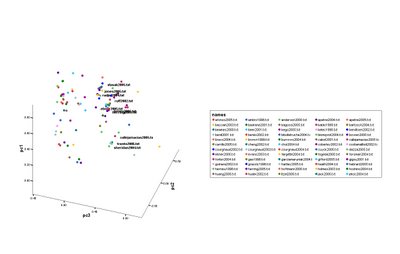
Essentially we are looking to get an idea of how people do their phylogenetics
by extracting it from papers. Im doing pretty well with the extracting side of things but how to visualise the data isn't so straightforward. Should it be a network and ontology or just a chart and what is the best way to visualise these.
Essentially we are looking to get an idea of how people do their phylogenetics
by extracting it from papers. Im doing pretty well with the extracting side of things but how to visualise the data isn't so straightforward. Should it be a network and ontology or just a chart and what is the best way to visualise these.


Thursday, January 12, 2006
Consensus trees and XML models
Read a lot of Felsensteins work on consensus trees.
Ml consensus tree methods "l" varies from 0% to 100% as a value that is used to determine if a group should be collapsed. e.g. l = 50%, so all groups that occur in more than 50% of the trees will be drawn in the final consensus tree. 50% is the value used in the Majority Rule Consensus Tree (MRCT) method. Obviously because anything over 50% has to be in the majority.
Still working on literature review, not sure how much i've written, but theres definitely some very core sections still to write.
Wanted to try out tree-like data structures in java today. Thought occured to me to create java data structures that represent all objects from phylogenetics. But it would need java which makes it a bad idea. A better idea was to create XML schema or models (or whatever the word is) for each entity within the great phylogenetic ontology.
I should try to do this above. I might try it for a DNA sequence.
Need to think about what elements a sequence needs, what are the elements, what are they called, what type are they, what data do they contain.
draft DNA sequence XML schema
ID TYPE DATA
---------------------------------------------
NAME STRING GI345642
LENGTH INTEGER 20
DNA STRING CATCGTCGATCTCGATCGAT
---------------------------------------------
transferring these between programs would make things a lot easier.
you would still need a parser for taking data from a prog and converting it to this and then putting it into this.
If we surround existing software with a transparent data transfer service we need a million interfaces to interconvert data. LOTS of boring text parsing. A waste of time.
We need a core set of components that all talk to each other using a standard defined ontology.
People would only use a system of this type if it had all the features they use, rather than trying to provide it for them. Tools should be made available that can put custom progs into the system. Or at a stretch tell people how to rewrite their software to work with system but this prob wouldn't work.
I should provide custom versions of the most popular software, e.g. blast, clustalW, phylip.
Big job really, but perhaps a toy system could work, I could use it to link units together each units having inputs and outputs. A bit like IRIS explorer.
Ml consensus tree methods "l" varies from 0% to 100% as a value that is used to determine if a group should be collapsed. e.g. l = 50%, so all groups that occur in more than 50% of the trees will be drawn in the final consensus tree. 50% is the value used in the Majority Rule Consensus Tree (MRCT) method. Obviously because anything over 50% has to be in the majority.
Still working on literature review, not sure how much i've written, but theres definitely some very core sections still to write.
Wanted to try out tree-like data structures in java today. Thought occured to me to create java data structures that represent all objects from phylogenetics. But it would need java which makes it a bad idea. A better idea was to create XML schema or models (or whatever the word is) for each entity within the great phylogenetic ontology.
I should try to do this above. I might try it for a DNA sequence.
Need to think about what elements a sequence needs, what are the elements, what are they called, what type are they, what data do they contain.
draft DNA sequence XML schema
ID TYPE DATA
---------------------------------------------
NAME STRING GI345642
LENGTH INTEGER 20
DNA STRING CATCGTCGATCTCGATCGAT
---------------------------------------------
transferring these between programs would make things a lot easier.
you would still need a parser for taking data from a prog and converting it to this and then putting it into this.
If we surround existing software with a transparent data transfer service we need a million interfaces to interconvert data. LOTS of boring text parsing. A waste of time.
We need a core set of components that all talk to each other using a standard defined ontology.
People would only use a system of this type if it had all the features they use, rather than trying to provide it for them. Tools should be made available that can put custom progs into the system. Or at a stretch tell people how to rewrite their software to work with system but this prob wouldn't work.
I should provide custom versions of the most popular software, e.g. blast, clustalW, phylip.
Big job really, but perhaps a toy system could work, I could use it to link units together each units having inputs and outputs. A bit like IRIS explorer.
Thursday, November 03, 2005
I like this - its like a portable google search for your browsing
History SearchFlock comes with the open source Clucene search engine built in. Each time you visit a web page, it indexes all the content on that page so you can easily retrace your steps later. Pages you've starred as Favorites float to the top when you do a History Search. History Search is stored locally for privacy. For more privacy, you can wipe it out using the Clear Private Data command.Example: 1. Visit some interesting web pages, such as Yahoo News. 2. Start typing a few letters of a search query (for example "tech") into the search box. 3. After you type a few queries, a menu appears showing you matching results from your browser history and pages you have starred. You can use the keyboard to navigate through the menu. 4. When you press Enter, a normal web query is done using the search engine you have chosen.
Subscribe to:
Posts (Atom)
